
Gemstone Certification
Independent identification, geographic origin, and treatment disclosure for natural and synthetic colored gemstones — backed by spectrometric evidence and a gemologist's signature.
A gemstone's value is determined by what it is, where it came from, and what was done to it. Our certificates document all three using the same standards-based methodologies that GIA, SSEF, and Gübelin apply. Every conclusion on a GSR report rests on instrumented evidence, not opinion.
Species and variety
Gemstones are first identified by mineral species (crystallography & chemistry) and then by variety (color, optical signature, trade name). The same species can yield very different gems.
A ruby and a blue sapphire are both corundum. An emerald and an aquamarine are both beryl. Species classification is the foundation of every gemological cert — it determines which testing methodology applies and which treatment markers we look for.
What appears on a Gemstone Certificate
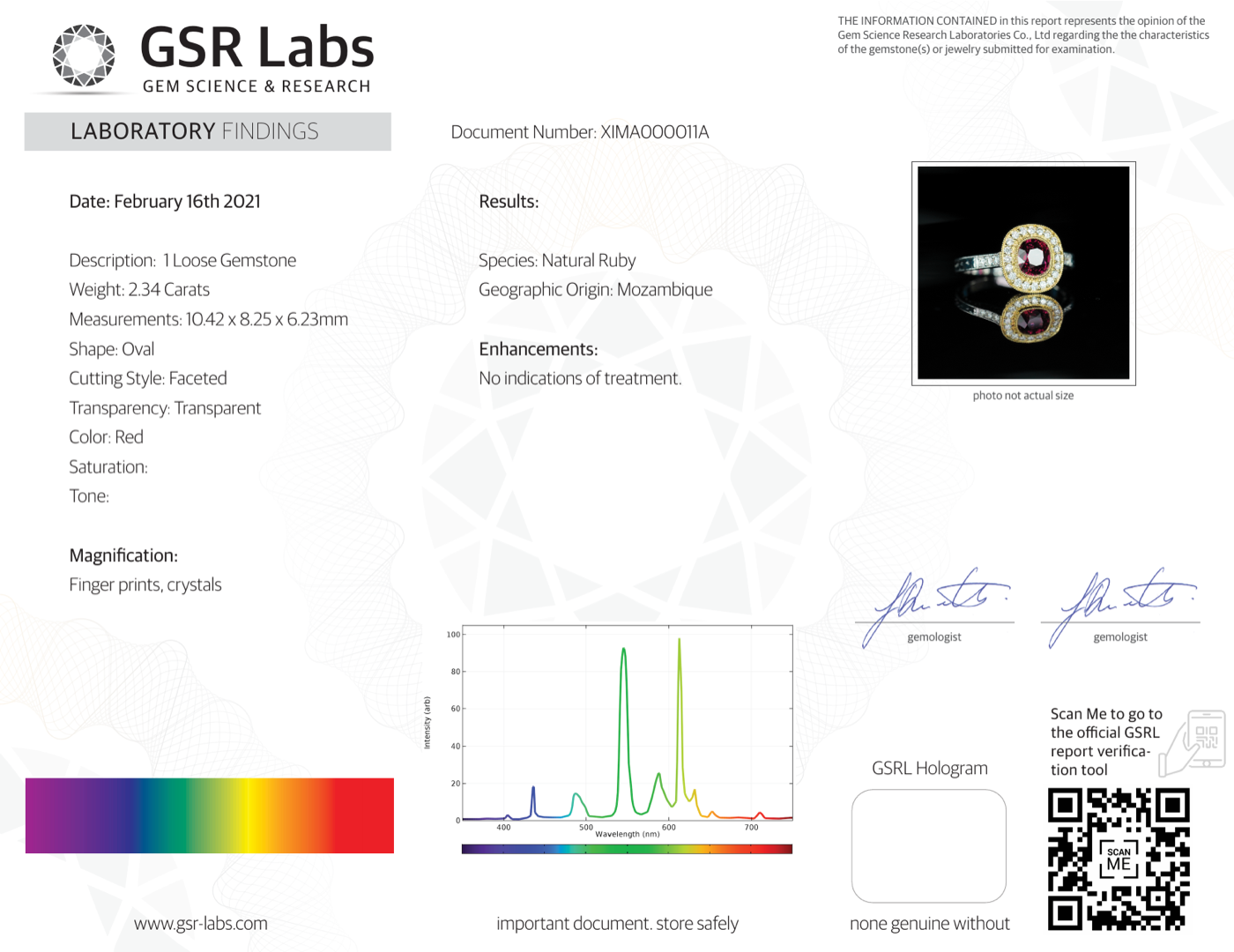
Species & Variety
Natural Ruby, Natural Sapphire, Natural Emerald — the technical and trade name your stone is sold under.
Geographic Origin
Probable country of origin where determinable, e.g. Mozambique, Burma, Sri Lanka, Madagascar, Colombia.
Weight & Measurements
Carat weight to two decimals and length × width × depth in mm.
Shape & Cutting Style
Oval, cushion, round, pear — and the cutting style (faceted, cabochon, mixed cut).
Color, Saturation, Tone
Hue (red, pigeon-blood red, royal blue, vivid green), saturation, and tone descriptors.
Treatments Disclosed
Heat treatment, oiling, fracture filling, irradiation, beryllium diffusion — disclosed explicitly per CIBJO / ICA conventions.
Gemologist Signature
Every certificate is personally signed by the responsible gemologist. No automated stamps.
QR Verification
Scannable QR code links directly to the online record — anyone can verify in seconds without an account.
How we determine origin
Geographic origin opinions combine three independent evidence streams. A definitive opinion requires all three to agree.
Three confidence levels
- Definite origin — all three evidence streams point to a single source country. Stated unambiguously.
- Probable origin — primary indicators point to a source but with some ambiguity. Stated with "probable".
- Inconclusive — evidence overlaps multiple regions. We state this plainly rather than guess.
We will never overstate an origin opinion to fit a client expectation. If the data is inconclusive, the certificate says so.
Treatments we detect & disclose
Following the ICA Common Disclosure Code and CIBJO Blue Book conventions, we identify and disclose every treatment we find.
Common treatments
- Heat treatment — permanent enhancement of color/clarity. Detected by inclusion alteration, FTIR signatures, and UV-Vis-NIR features.
- Oiling & fracture filling — emeralds, rubies. Detected by microscopic examination and FTIR.
- Irradiation — color enhancement (blue topaz, some yellow sapphires). Detected by absorption spectra and decay characteristics.
- Beryllium diffusion — lattice-altering Be diffusion in corundum. Detected by LIBS / chemistry.
- Glass filling / lead-glass composite — common in low-quality ruby. Detected microscopically and by SG variance.
- Surface coating — color-coating thin layers. Detected by Raman and microscopy.
Built for the trade, the trade public, and everyone in between
Gem Dealers
Cleared documentation that survives due diligence — origin, treatment, identity in one document.
Private Collectors
A neutral, signed record of what you own — supports estate planning, resale, and insurance.
Insurance Carriers
A foundation document for scheduled-item riders — paired with replacement-value appraisal where required.
Estates & Auctions
Authoritative cataloging documentation that meets auction-house and probate requirements.
What your finished certificate looks like
Every cert ships on lab letterhead with the gemologist's signature, an embedded GSRL hologram, and a QR code that links to the online verification page.
A digital copy is archived in our permanent database; if the printed cert is ever lost, the record is one search away at gsr-labs.com/verify.
Gemstone certification FAQ
How accurate are gemstone color grades?
Color description follows controlled lighting standards (typically D65 daylight equivalent at 5500-6500K). Two qualified gemologists viewing the same stone under the same conditions should reach the same hue / saturation / tone descriptors. Color is inherently more subjective than measurements like weight or refractive index, which is why we use formal vocabulary and reference samples rather than free-text impressions.
Is geographic origin determination reliable?
For ruby, sapphire, and emerald it is generally reliable when supported by all three evidence streams (inclusions, trace elements, UV-Vis-NIR). For some sources — for example, distinguishing certain Sri Lankan sapphires from Madagascar — the data overlaps and we state the result as "probable" or "inconclusive". A definite opinion is reserved for cases where the evidence clearly points to one country.
Why does the lab sometimes say "probable" instead of "definite"?
Geological sources of gemstones overlap in chemistry and inclusion content. Where the data is unambiguous, we say so. Where it is suggestive but not conclusive, "probable" is the truthful answer. A definite-origin opinion on a stone where the data warrants only "probable" is professional malpractice — we do not issue them.
Can you certify mounted gemstones?
Yes for most ID work. Species, variety, and many treatments can be determined while a stone is set. Full clarity grading, exact dimensions, and detailed origin determination usually require the stone unmounted because some instruments need direct optical access.
Do you certify gem rough?
Yes. Rough gemstones can be species-identified and origin-tested even before cutting. The cert documents what we observe pre-cut; a new cert can be issued after cutting if desired.
What if the result is inconclusive?
We state it on the certificate. An inconclusive origin or treatment result is itself a valuable conclusion — it tells dealers, insurers, and buyers that the standard methodology could not resolve the question. It is more honest than a forced answer.
How do you detect synthetic ruby and sapphire?
Natural and synthetic corundum share chemistry but differ in growth structure. Flame-fusion synthetics show curved striae under magnification. Flux-grown synthetics carry flux inclusions and characteristic UV fluorescence. Hydrothermal synthetics often show seed-plate and chevron patterns. Where microscopy is ambiguous, FTIR and UV-Vis-NIR resolve it.
Can the cert be re-issued if I lose the printed copy?
Yes. Every certificate remains in our online database permanently. Re-issued printed copies are available on request; anyone can also verify at gsr-labs.com/verify using the cert number.
Have a gemstone to certify?
Send us a photo and we'll recommend the right report and quote turnaround.
Submit an Item